
Brunello masterclass - hosted by Italian specialist Marcel Kustos
From Eventbrite · Last checked 5 Nov. That's our last look, not a live ticket check.
Event details may change. Confirm times, availability and prices with the organiser before attending.
The lowdown
Our first session sold out very quickly (Tuesday Nov 17) so we have announced a second session on Wednesday November 18th! Details here:
This promises to be one of our best masterclasses of the year. The wines featured have been some of my favourite bottles of the past 12 months, so it will be exciting to open a number of them side by side. This comes in conjunction with a big focus on Montalcino in our upcoming annual Christmas newspaper The Oracle. My article below. Please join us for what should be a great tasting hosted by myself and Italian specialist importer Marcel Kustos of David Ridge imports. – Ches Cook, Five Way Cellars.
The lineup:
Ciacci Piccolomini d'Aragona Rosso di Montalcino 2024 $82
Ciacci Piccolomini d'Aragona Brunello di Montalcino 2021 $185
Baricci Rosso di Montalcino 2024 $110
Baricci Brunello di Montalcino 2021 $220
Poggione Brunello di Montalcino 2020 $165
Costanti Brunello di Montalcino 2020 $320
Argiano Brunello di Montalcino 2020 $175
Cerbaiona Grammatica Toscano Rosso 2023 $110
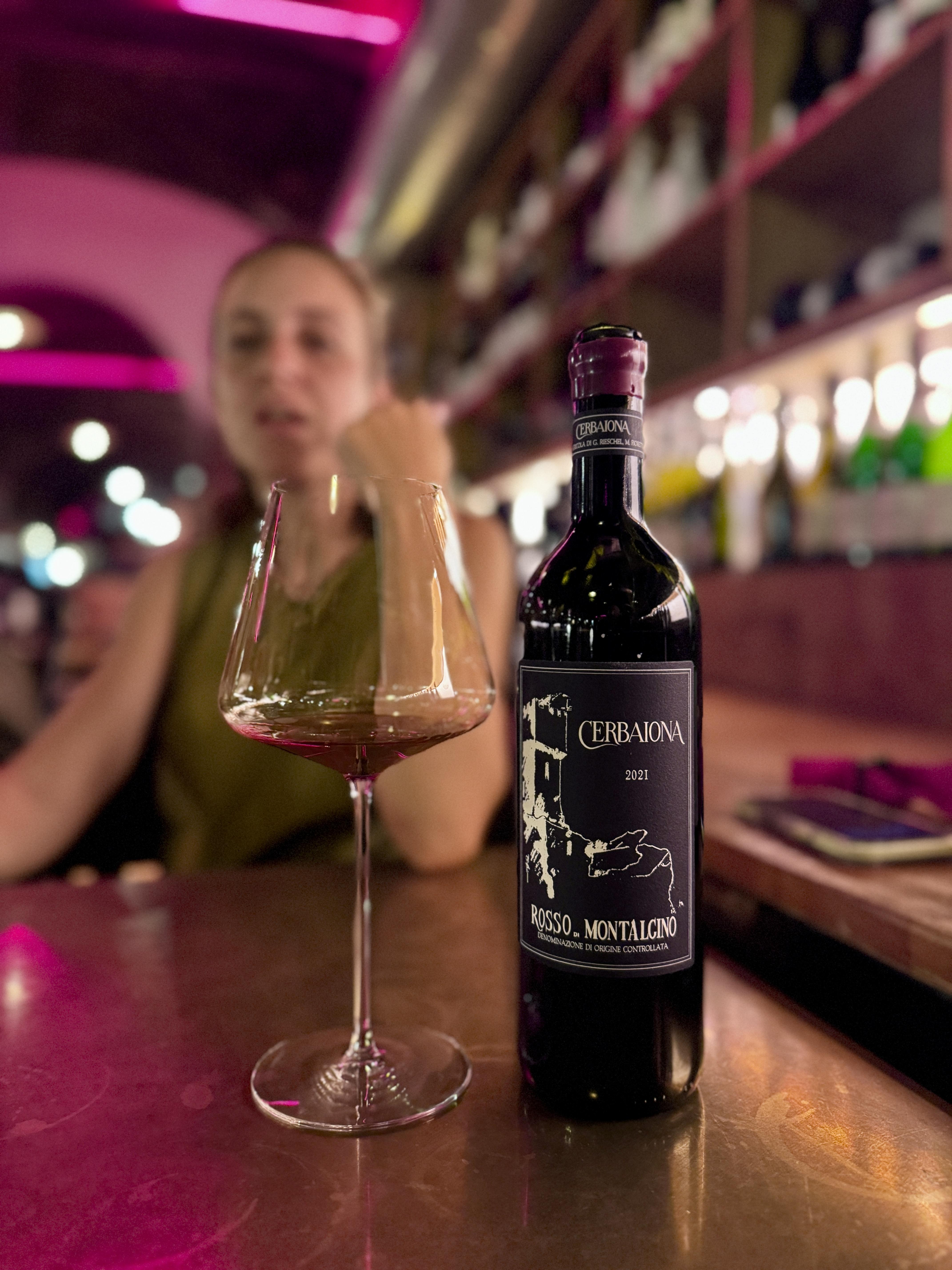
Cerbaiona Rosso di Montalcino 2023 $215
Cerbaiona Brunello di Montalcino 2021 $570
A Rekindled Love of Brunello Di Montalcino
This year has been a year of rediscovering Brunello di Montalcino. For a while I had lumped a lot of Brunello in together, having lost enthusiasm for some of the wines due to some fairly big and blocky examples in recent years. However lately, producers such as Cerbaiona, Baricci and now Ciacci Piccolomini d'Aragona have brought huge interest back to the region and wine style. These wines tend to share similar traits: they are medium bodied, bright and lively. They don't have an interest in showing-off sheer power, and none of them are looking for oak flavours or high alcohols. Rather, they show the potential of Sangiovese to be an elegant, layered and silky wine and one very capable of translating its terroir.
Montalcino is a region of Tuscany, just south of Siena. Historically it has never been broken down into a cru system (such as in Barolo or Burgundy) where recognised vineyards are mapped, named and regularly appear on labels. Such a system can be very helpful in understanding the intricacies of a region and identifying sources of exceptional fruit across various producers. Here in Tuscany though, despite the cru system not existing, there has been more effort in recent years put into identifying sub-regions of Montalcino and distinguishing why these sub-regions are different from one and other (climatically and in terms of soil composition) and how the terroir of such sub-regions is translated through wine.
Specialist importer David Ridge has summarised the sub-regions of Montalcino very succinctly, so I share his insights here:
North of Montalcino, the limestone-riddled ‘Galestro’ soils and a cooler climate result in sleeker, more compact wines, where their underlying structures and finishes are more prominent. [Producers Cerbaiona, Baricci, Fuligni and Costanti all fall within this zone]. Perhaps from these, you expect the least fruitiness, and the descriptors tend more to the smoke, undergrowth, stock/soy, dark spices and porcini notes. South of Montalcino and to the east the soils of the slopes are loam and silty-sandy, the wines are more powerful and show richer notes of dark fruits and tar, some blackberry, but plenty of the soy/stock things too. [This where you will find huge favourite Poggio di Sotto and Ciacci Piccolomini d'Aragona]. Over in the southwestern section are the ripest and brawniest wines… in general; and here you’ll expect some jam, raisin, chocolate and prune, in wines that need all the structure and acid zing they can muster. In siting of vineyards for the best results, they’re looking for elevation and avoiding too much clay. [Soldera is located in the southwest and is a true unicorn and outlier, producing unequivocally the most elegant and ethereal wine of the region].
Where in Piemonte, the region for a while was split by modernists (often typified by the use of barrique/new oak, shorter macerations, more aggressive ferments and more fruit-rich wines) and traditionalists (old large-format wood, long macerations, more austere wines in youth with firm tannin profiles) a similar story was playing out in Toscana. Today, while many are embracing winemaking technology, the best wines are returning to (or never left) a more elegant and understated style. Certainly the wines we favour most are coming from producers who eschew new wood and signs of artifact in their wines in favour of more transparent and terroir-expressive styles. Cerbaiona, for example, refuses to make a Riserva wine. The idea that leaving wine in wood for a longer period of time somehow elevates it to a higher standard is a flawed concept, if you are to ask current owner and winemaker Matthew Fioretti. It’s hard to disagree. Having said that, other producers who we love do make Riserva wines and do have their own reasons for doing so…
Mention must also go to Brunello’s younger sibling, Rosso di Montalcino. These wines can offer so much immediate enjoyment whilst still singing the song of Montalcino very clearly. Ageing requirements are much shorter and typically producers will use the Rosso di Montalcino DOC to either declassify fruit that didn’t quite make it into their Brunello bottling or will use young-vine fruit material to produce these wines. Rossos from top producers can be an absolute joy to drink, typically at half the price of their Brunello equivalent.
As Montalcino continues to hone-in on identifying what makes it such a special place to make wine, vintages such as 2021 have helped to shine light on the quality on offer here. 2021 was a 10/10 vintage for the region and some of the wines that came from this year are remarkable. It has been a real treat to drink some of these wines over the past twelve months. A combination of exceptional sites, gentle and intuitive winemaking and favourable vintage conditions have resulted in wines brimming with personality and identity; wines that are hugely enjoyable now while suggesting that they will only improve over the next decade and beyond if laid to rest in a cool cellar. – Ches Cook, Five Way Cellars.
Where to rock up
Five Way Cellars, 4 Heeley Street, Paddington, NSW 2021, Sydney